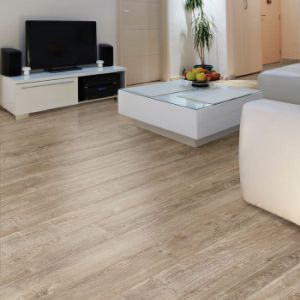
 The coated sheet obtained by impregnating the paper with the desired color and pattern in the printing house with resin is called laminate. The resin impregnation process is also called paper impregnation. Impregnation is the process of drying the papers impregnated with resin materials such as melamine formaldehyde and urea formaldehyde by oven.
Laminate floor covering is produced by gluing laminate veneers on MDF, HDF or chipboards of 7-8 mm thickness, which are cheaper than qualified wood. There are also those produced using carcinogenic adhesives. Bonding is done under heat and pressure using glue. The boards produced in large layers are cut to desired dimensions, the joints are opened according to the attachment detail and packaged and presented for use. Laminate flooring does not require any treatment such as leveling or polishing.
The first laminate flooring product in the world was produced in 1980. However, Parke was launched in 1982 as a new product due to its R&D studies. Since then, laminate flooring has quickly become demanded in European countries. Lack of desired shape and quality in the first years of laminate flooring production led companies to research and development. At the end of 1985, laminate flooring has achieved many successful results that make it more advantageous than other flooring products.
Laminate flooring (zemin kaplama), which is extremely easy to install, clean and maintain, is the most widely used decorative floor covering because it is suitable for all kinds of tastes and designs in terms of color and texture variety. Laminate flooring, which is fully resistant to impacts, liquid cleaning agents, abrasion, scratching, sun rays and cigarette fire, is extremely suitable for bank, hotel, shopping malls and all workplaces with heavy traffic.
Why Laminate Flooring?
Decreasing tree varieties.
Three-dimensional working feature of wooden material.
Maintenance difficulties of wood.
The increasing cost factor in wood materials has led all consumers to turn to wood-based derivative materials and to enjoy these materials in the long term.
Laminate material is examined in three groups,
HPL high pressure laminate
CPL continuous pressure laminate
DPL direct pressed laminates
The surface of the laminate flooring in the HPL group is thermoset based. This property is due to thermosetting resin. The main feature of thermoset-based resins is that the surface formed after heat and pressure cannot be deformed later by temperature. In laminate flooring, all films are impregnated with thermoset based resin.
Basic Structure of Laminate Flooring
Overlay: It is a cellulosic based film layer in which aluminum oxide parts are placed. Aluminum oxide parts are the basic element that provides resistance against wear, scratches, heat, and it is the most important feature that distinguishes laminate flooring from similar derivatives.
Decoration Layer: It is a paper film layer printed with advanced technology that can be produced from high quality wood raw materials in endless colors and patterns.
HDF: High density non-carcinogenic (E1) and water resistant fiberboard. It should not contain carcinogenic substances according to ISO and DIN norms.
Balance Paper: Cellulosic paper film layer providing stabilization.
BASIC STRUCTURE OF LAMINATE PARQUET
Laminate flooring is a product consisting of four main components or layers, and each layer has a separate role in the appearance and durability of the flooring. These layers are from bottom to top:
The lowest layer is a paper or melamine support layer, known as a balancing layer, and prevents moisture from the floor by ensuring a balanced fit of the parquet.
Made of high-density fiberboard (HDF), this core layer is the water-resistant main carrier layer. HDF is obtained by compressing wood fiber with glue and resin.
The decorative layer is the layer that gives the parquet a real tree appearance. This layer is essentially a photograph, made by compressing several layers of paper with melamine resin. True colors and mother-of-pearl paint provide a deep décor and a real image. This decor sheet starts with a large wood texture photo and is segmented into laminate board sizes. Because the same photo is used for many boards and it is possible to re-pattern according to the condition of the boards.
The top protective layer is the layer that resists abrasion. This layer is a coating layer made of transparent aluminum oxide. This coating layer can be of low or high gloss depending on consumer trends. This layer prevents moisture from penetrating the wood. This layer quality varies by brands.
All these layers are put on top of each other and fused to form a whole with high heat and intense pressure. The core layer of some boards is thicker than others and shows good strength in every application. In other words, the thicker the core of the wood, the greater its durability. The core layer is measured in millimeters and its quality depends on the grade of the product and the class specified by the manufacturer.
 Flooring Systems